My Story
My mom is a two-time breast cancer survivor. Her own mother died when my mom was nine.
By the time my mom was diagnosed the second time, they knew she had BRCA—but it was just a line on a report. BRCA1/2. Nobody really knew much about it yet, and nobody explained it. I think my parents came out of my mom's experience truly traumatized. I love them so much, but their entire approach was protection. Don't look. Don't find out. Wait and see.
I knew I needed to know.
So I went and found out for myself.
I was in grad school in London, where the testing is free, and I thought, you know what, I might as well. I was 25, single, and terrified.
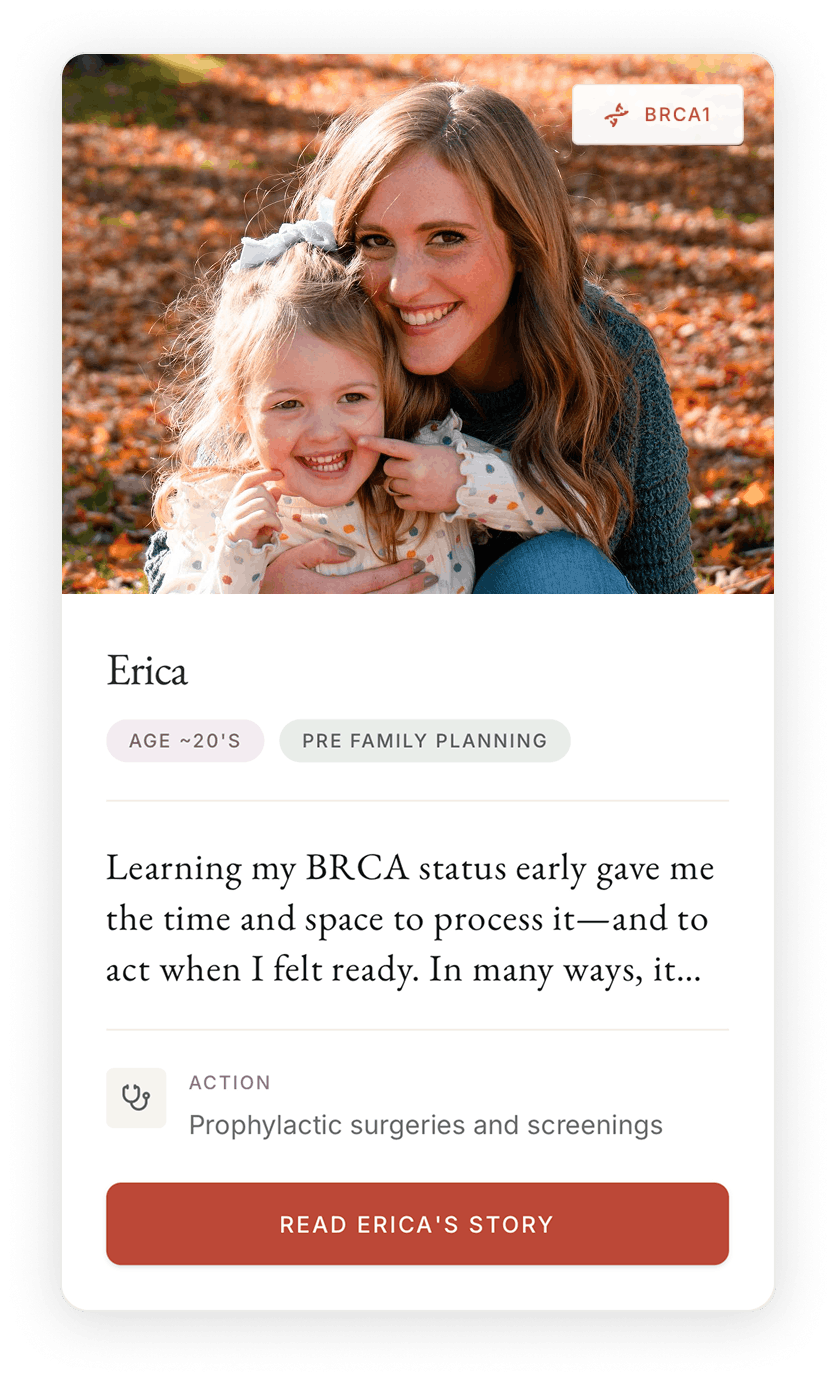
I found out I was BRCA2 positive.
How I Felt When I Found Out
There wasn't really anyone to talk to about it.
My parents really didn't want to talk about it. I didn't have a GYN in London let alone an oncologist. Instagram existed but it wasn't yet a place you went for information. There was nowhere to go and ask, what is this and what are my options?
What I did have, almost by accident, was the UK. They have a program there that pays for your first child through PGT-M. That's the only reason I learned embryo testing existed at all. At 25, newly positive, in another country—that was one of the first pieces of information that made me realize knowing my status could give me choices and control in my future.
How I Thought About Risk
It took me a long time to fully understand what those choices actually meant.
I have a master's in reproductive and sexual health research. I work at Memorial Sloan Kettering in the Young Women with Breast Cancer Program. I worked on a BRCA fertility trial. I understand the language.
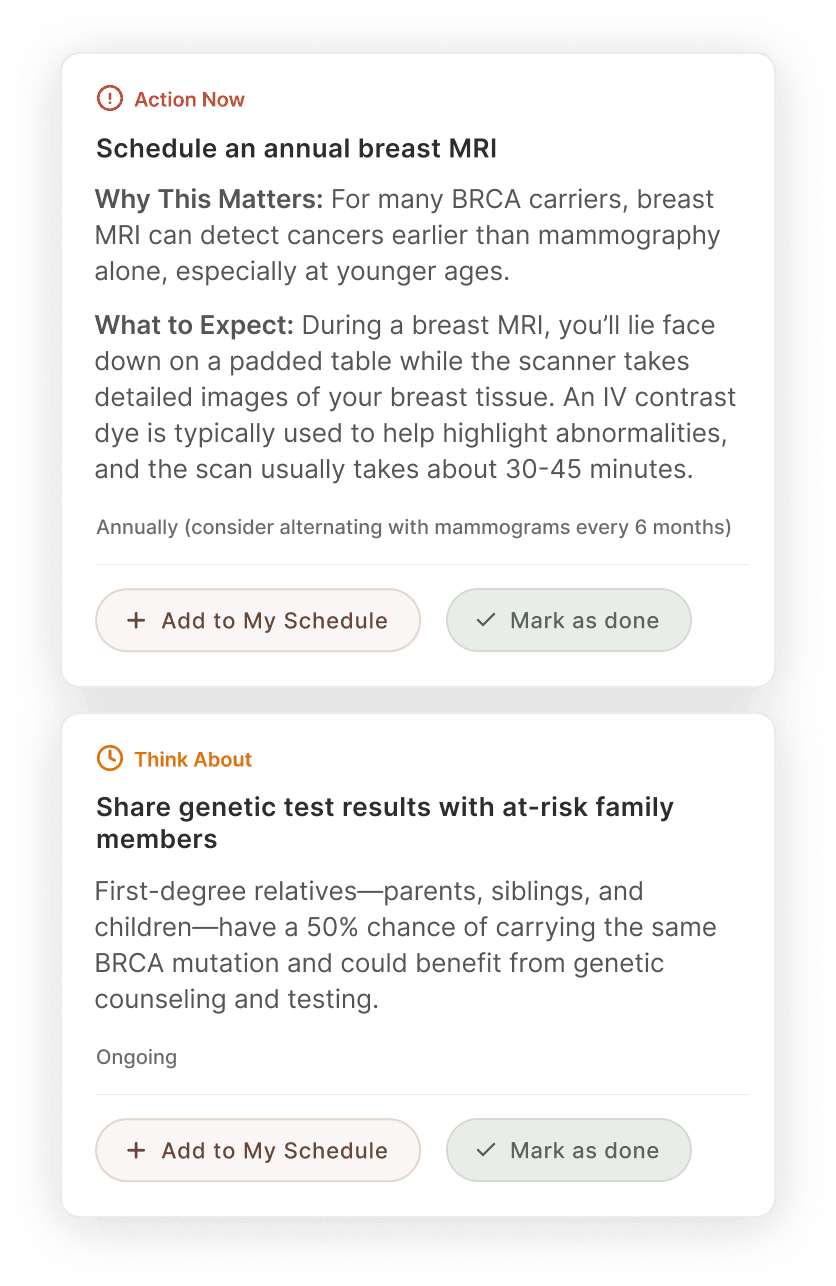
And it still didn't fully click for me that what we call surveillance is screening—that screening means waiting to find out if and when I get breast cancer. And if that happens, the outcome is a double mastectomy, and chemo, and most likely an oophorectomy. And after that, I can't do hormone replacement therapy during surgically-induced menopause, which is probably going to be my worst long-term symptom out of any of it.
Nobody said those things to me. I had to assemble them. For me, once I really understood that distinction, it changed how I thought about preventative surgery.
Even smaller things were never really explained. When I moved back from the UK, my birth control changed after my second egg retrieval, and no one talked to me about how hormonal changes could potentially affect things like libido. For a long time, I thought something was wrong with me.
I kept thinking: Why aren't we talking about all of this earlier?
The Decisions I Faced
For me, fertility came first, and it came much earlier than I expected.
Suddenly there were a million questions: Should I freeze my eggs? When should I have my mastectomy? Do I want to do IVF and PGT-M? What order am I supposed to do all of this in? How do I make decisions for a future family I don't even have yet?
That is a LOT to put on someone in their twenties.
PGT-M gave me something I really valued: the possibility of not passing BRCA2 on to my children.
PGT-M is IVF where you test the embryos. You can't test eggs or sperm, but you can test an embryo for BRCA—you need your familial line, some genetic swabs. It means you can break a genetic cycle if you're willing to go through it.
For me, that possibility felt incredibly empowering.
But I also know that having access to it is a privilege.
I have extraordinary insurance coverage, and our three IVF rounds have been covered. I am incredibly grateful for that, especially because I know so many people who would make the same choice if finances weren't standing in their way.
That inequity is a huge part of why I care so much about fertility advocacy and improving access to fertility preservation and PGT-M for people affected by hereditary cancer.
What Treatment and Recovery Were Really Like
I've now done three rounds of IVF.
And, to put it eloquently: I hate IVF. I literally hate it.
It is so much more than shots and retrievals.
It's appointments and waiting and phone calls and genetic testing and numbers constantly getting smaller. It's planning your life around cycles. It's getting good news and immediately realizing there's another hurdle after it.
And it takes a LONG time.
We started this process thinking we would do IVF, test our embryos and move on. Instead, it has become this huge chapter of our lives.
At every stage of IVF, you lose some.
You start with follicles. Then eggs. Then mature eggs. Then fertilized eggs. Then embryos. Then embryos that make it to biopsy. Then embryos that are chromosomally normal. Then, for us, embryos that are also BRCA-free.
So even when things are going well, you're constantly celebrating something while grieving something else.
Right now, we have four BRCA-free embryos, and we're waiting on PGT-M results from two more embryos from our third retrieval. We want two children, so we're still figuring out whether this is enough or whether there is another round in our future.
That uncertainty is probably one of the hardest parts. But IVF gave us something BRCA doesn't always give you: a choice about what we pass on.
Where I Am Now
I'm in the middle of it, which is the strange part about being a previvor. When are you a previvor—before, or during?
And I want to say this plainly, because I don't hear it enough: I had a good experience with my mastectomy and IVF so far. Insurance covered everything. I had an amazing hospital. My parents have become so educated about my choices and are incredibly supportive. My fiancé, now husband, never left my side through surgery and has been there through every shot, retrieval, result and breakdown since. My dog, Pierogi, has been my ultimate side-kick.
I am incredibly lucky.
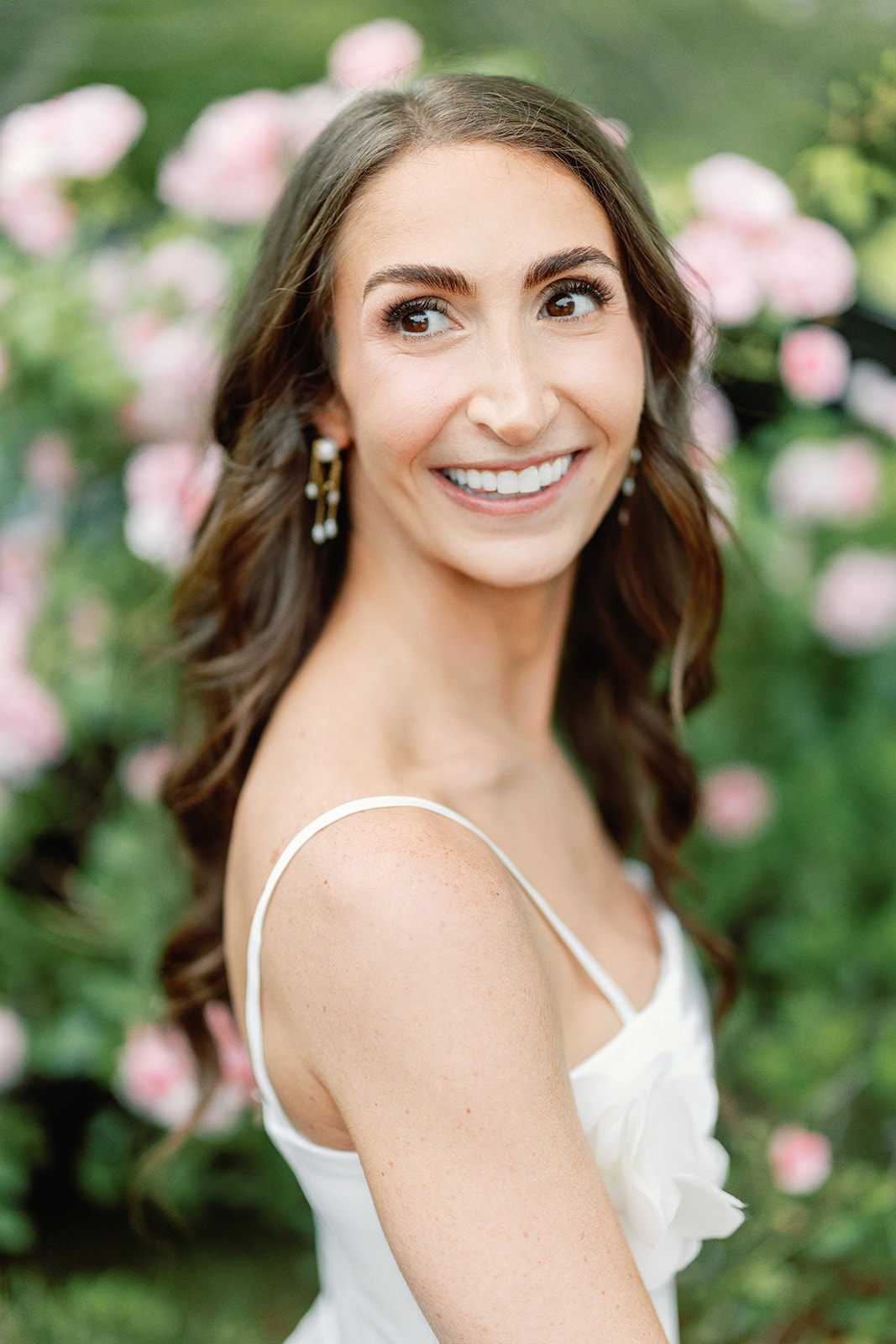
And I carry wounds from it. Both of those are true at once. Sometimes I even feel guilty talking about the hard parts because I know how fortunate I've been compared with so many women.
There are funny but honestly, hurtful, moments too. My friends occasionally refer to my mastectomy as my "boob job" because my reconstruction looks good. Moms will jokingly tell me they want what I had after breastfeeding. And I'm like... well, not exactly the same thing.
But I also understand that they mean it as a compliment, and I genuinely feel lucky that I can look at my body now and feel good about it.
What I'd Do the Same or Differently
I would get tested at 25 again. Even though I didn't have my family cheering me on to do it at the time, knowing early gave me choices.
It gave me time.
It allowed me to freeze my eggs. It allowed me to choose preventative surgery before cancer made that decision for me. It allowed my husband and me to pursue PGT-M.
What I would change is how much I had to piece together myself. I wish fertility had been part of the conversation from day one.
When a young person learns they carry BRCA, some of the first thoughts are often: Am I going to get cancer? Am I going to have kids? Could I pass this on to them? Am I going to be around for them?
Those questions deserve answers, or at least a conversation, right away. Not five years later. Not because another patient happened to mention it. Not because you found the right Facebook group at 2 a.m.
What I Wish I'd Had
A roadmap. That's probably the simplest way to say it.
BRCA gives you options, which is incredible, but options can also be completely overwhelming.
I wish someone had sat down with me at 25 and said: Here are the decisions you may face over the next ten or fifteen years. You don't need to make them today. But here is what they are, here is why timing might matter, and here are the people who can help you when you're ready.
I wish someone had talked openly about sexual health, hormones, surgical menopause and HRT.
I wish someone had told me that preventative mastectomy didn't necessarily mean I would hate my body afterward. For me, I actually feel more confident and comfortable in my body now.
What I Want You to Know
You're allowed to come back for support.
That has been one of the biggest lessons for me. After my mastectomy, I felt like I had received so much support that it was my turn to give it back. I became a peer navigator. I wanted to be the person saying, I did it. You can do it too.
Then IVF happened, and suddenly I needed people again.
I wanted someone who understood the ridiculous waiting. Someone I could text and say, We got our results. Here's where we are. Someone who knew why good news could still feel complicated.
I think that's what community really is.
Sometimes you're the person giving support. Sometimes you're the person who needs it. Most of us will be both, over and over again. You can tap in and out. You can take what you need, and when you're ready, you can give some of it back.
I don't think being a previvor is something you finish. There is always another decision, another milestone, another season. But you don't have to move through all of them alone.
This is one member’s personal experience, not medical advice. Talk with your care team about your own situation.